Reliable brain-inspired chips for safety-critical AI
Computer chips get smaller every year. Smaller transistors are faster and use less energy, but they are also more fragile. They vary more from one chip to the next, they wear out as they age, and radiation can flip the bits they hold. In a car, an aircraft, a satellite or a medical implant, an error like this is not acceptable.
BRAINS builds neuromorphic chips that stay reliable at these very small sizes. Neuromorphic chips are modeled on the brain. The brain runs on less than 20 watts and stays reliable even though its own building blocks are noisy and imperfect. It does this by protecting what matters most, and by adapting all the time. We apply the same idea to silicon.
The usual answer to unreliable hardware is to add more hardware, or to leave a large safety margin. Both cost power, speed and chip area, and they cancel out the benefit of making the chip smaller. BRAINS designs reliability into every layer at once, from the standard cells on the chip up to the learning rules that run on it. We put protection where the chip needs it, and we leave the rest lean.
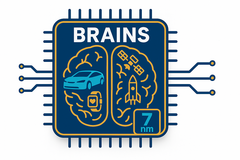
We will prove the approach in silicon. The project will produce a small spiking neuromorphic chip in a 7 nanometer process, and test it under stress, aging and radiation.
At a glance
- A 54-month project by two Dutch university groups
- Six user committee members from industry, space and healthcare
- A target of 10 to 100 times fewer failures, at a much lower cost in power, speed and area
- A 7 nanometer spiking neuromorphic test chip
BRAINS is funded by the Dutch Research Council (NWO), domain Applied and Engineering Sciences, under the Open Technology Programme 2025.